
The Anchorage Digital Prime Signal: What a Brazilian Election Night Taught Us About Prediction Markets and RWA Market Structure
TL;DR: The unexpected result of the Brazil presidential election on the evening of Sunday October 25 produced one of the most stunning market shifts in recent memory. The availability of 24-hour pricing from prediction markets and from an RWA perpetual future on Hyperliquid, and the fact that the BRL CME futures contract opened that evening provide interesting market structure insights. That night’s lesson was that a prediction market quickly adapted to the new reality, the EWZ Hyperliquid perpetual future reacted faster than CME BRL futures in the first few minutes, but it was stuck in a sequence of limit-down price barriers due to interesting dynamics related to oracle and mark prices.
Three screens, one result
Brazil's presidential election runoff produced a historic upset that led the local stock index to drop by 14% after hitting an intraday drop of 17% and hitting its first circuit breaker since the COVID crash, the yield curve jumped by 150-250 basis points, and the BRL to drop around 8% against the USD the next day.
Setting aside the political and economic reverberations, this episode provides exceptional insights for market structure wonks like myself.
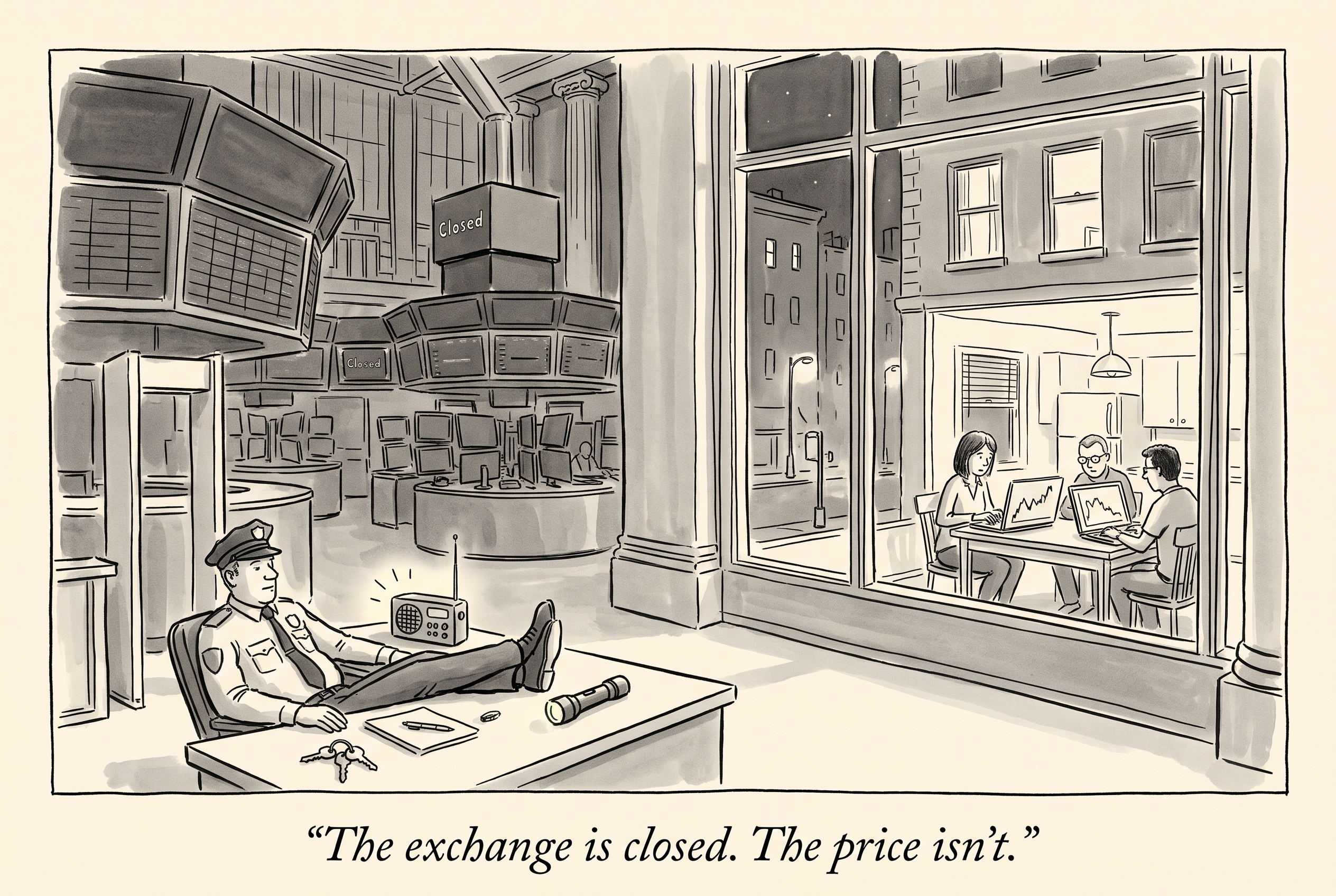
B3, the Brazilian stock exchange, closed Friday and did not reopen until Monday. The iShares MSCI Brazil ETF (EWZ), the instrument through which most foreign money expresses a Brazil view, was also closed on the NYSE. But a few markets were open that night: prediction markets on the election outcome, an EWZ perpetual future trading on Hyperliquid, and a CME future on the Brazilian Real (BRL) that opened at 7pm Brazil time (BRT), right at the time that the vote counting process started.
We pulled tick-by-tick data on the relevant Polymarket prediction market (33,167 trades), the Hyperliquid EWZ perpetual futures contract (58,805 trades), and minute-by-minute candles from the CME’s November BRL contract during that night to answer three questions:
- How fast was the prediction market able to re-price the new reality?
- Who reacted first, the Hyperliquid EWZ perpetual contract or the CME BRL futures contract?
- What happens to a relatively illiquid 24/7 perpetual on a closed underlying when that underlying's value drops by a quarter in a matter of hours?
Signal 1: Polymarket repriced the election in minutes, against a vote count that still said otherwise
Polymarket's market on a Lula win had him at 20% to 23% through Sunday afternoon, on $0.56 million of fills (premium paid). During the two-hour voting extension, it climbed to 35% on another $0.55 million. From the moment the count resumed at 19:00 BRT (22:00 UTC) the market needed only eight minutes to cross even odds: the first trade at 50 cents printed at 22:07:20 UTC and the last fill below it at 22:08:29. It touched 85% at 22:25, fell back to 61% at 22:46 in the one real hesitation of the night, and then ground higher without a pause: 90% by 23:16, 97% by 23:45, 99% at 23:55, and 99.7% at 00:05, by which point 94% of voting sections were in; the court declared the result mathematically settled three minutes later, at 98%.
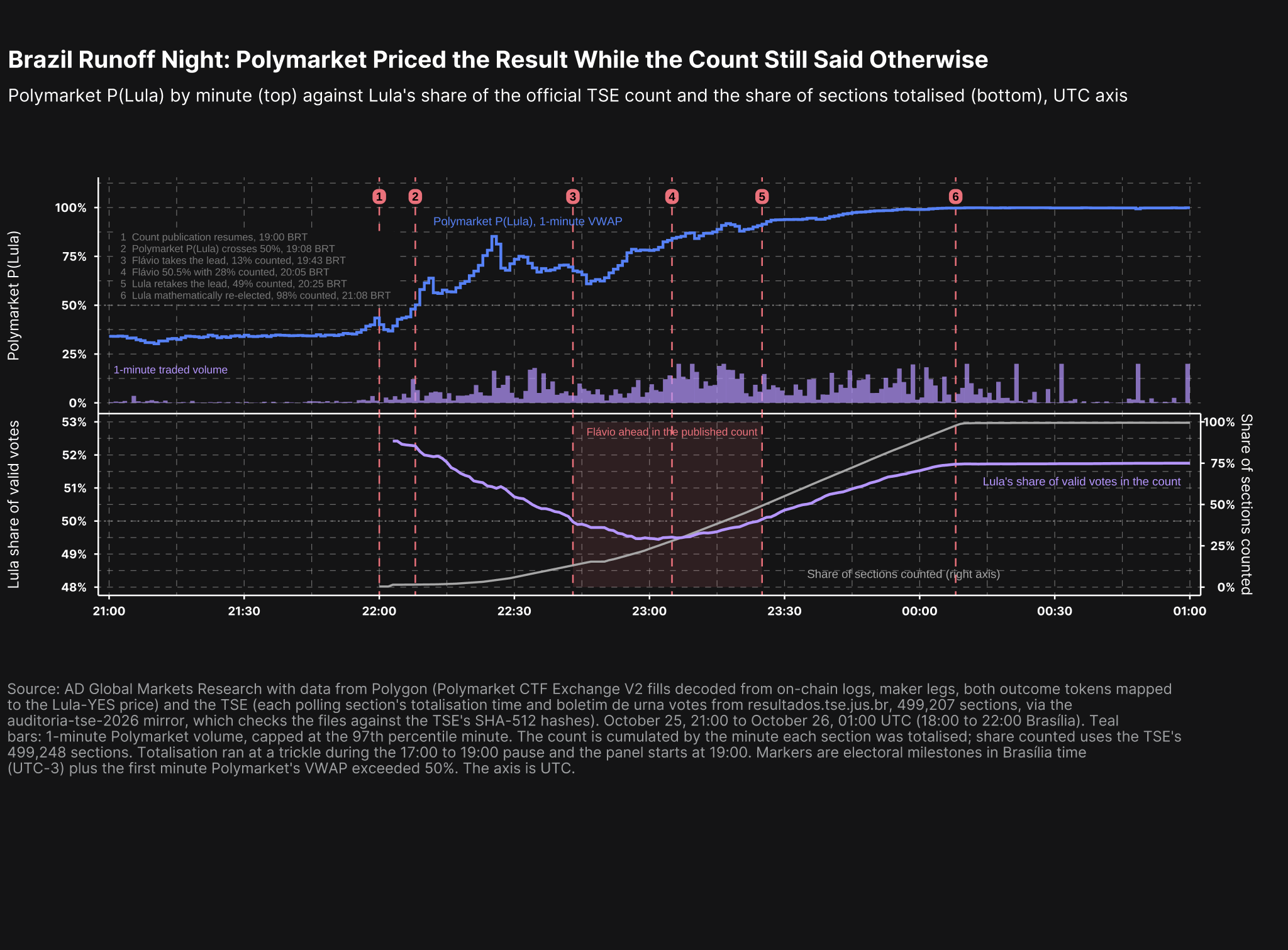
Interestingly, net taker flow was tilted to the sell-side through the Lula win odds rally. Between 22:30 and 23:30 UTC, while the official count went from 6% to 55% of sections and the published tally never left a point of 50-50, aggressors were net sellers of Lula, and odds rose from 73% to 94% anyway. Prices rose because likely due to resting orders being repriced upward on the count, not because takers lifted them. Over a third of the shares traded (36%, or 47% of fills) matched a Lula buyer directly against a Bolsonaro buyer through Polymarket's complete-set minting, which is the mechanism that lets the book absorb one-way flow without a market maker on the other side. Participation was relatively wide: 3,310 distinct aggressors and 951 distinct resting accounts between 21:00 and 01:00, with the five largest aggressors representing 31% of the total volume.
All in, Polymarket repriced the new reality in minutes, and it did so against the grain of its own order flow: the price went from even odds to 94% while the accounts crossing the spread were net sellers. The information was on the passive side of the book. That is the opposite of the usual microstructure story, in which aggressive flow carries the information and market makers lean against it.
The main caveat is this market’s size. The whole evening traded $11.6 million of collateral across a little over 33,000 trades with a median fill of $27, the largest single print was $1.4 million, and the five largest aggressors were a third of volume. As we’ll see below, the CME BRL futures traded more notional in its first hour than Polymarket did all night.
Signal 2: The 24/7 perp moved first, the CME real future took seven minutes to find its footing
Hyperliquid’s EWZ contract is a perpetual future contract on the iShares MSCI Brazil ETF. On Sunday evening it was the leading Brazil-equity price in the world that investors could access. As the election results started to come out after 19:00 BRT, the first batch with 1.4% of sections landed at 19:03 BRT with Lula at 52.4%. The perp was down 2.3% from its late-afternoon level in the first minute of the count and 5.0% by 19:03 BRT, on 1,581 trades and $1.5 million in the first ten minutes. Polymarket at that point was still oscillating between 37% and 43% and did not cross even odds until 19:08 BRT. CME’s November real future, which opened at the same 19:00, went the other way. Its first prints were 1.6% weaker than the Friday’s close price, and from there it rallied for seven minutes to 20.125 cents at 19:07, briefly above Friday’s close, while the perp was already 5% lower. It fell back through Friday’s close at 19:09 and did not look back: down 2% by 19:20 BRT, 5% by 19:32 BRT and 9% by 20:15 BRT.
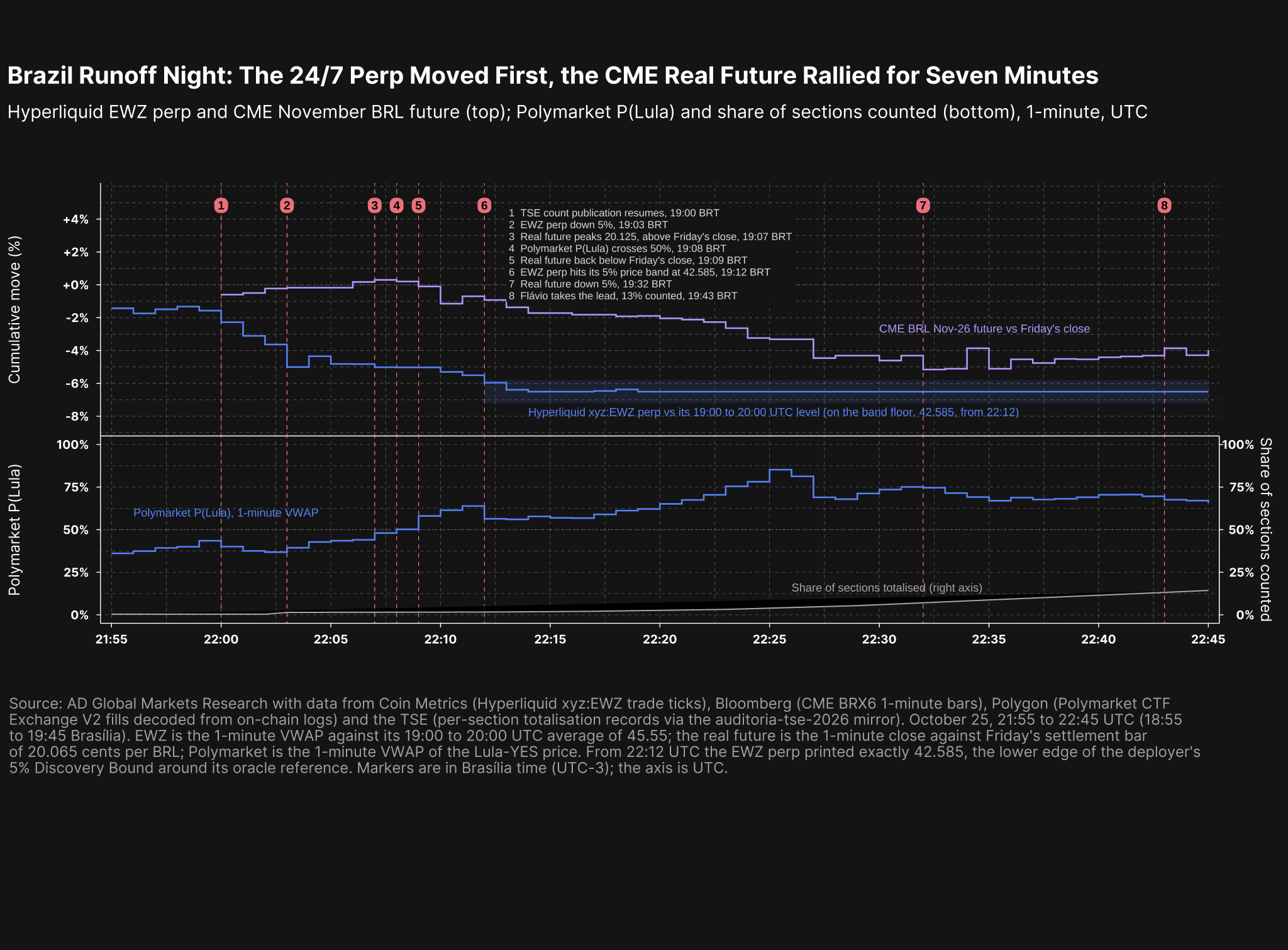
The order of these events matters. A contract that never closes carries positioning into the event, and it had rallied 8.6% from Friday’s US close of 42.65 to a peak of 46.30 on 17:05 BRT on the expectation of a Flávio Bolsonaro win. The CME BRL future, on the other hand, spent its first minutes finding a level. The EWZ perpetual contract has limited liquidity ($1.5 million of net taker selling took it down 4.7% between 19:00 and 19:12), but for the first ten minutes of the count, the Hyperliquid EWZ perpetual repriced before the CME Brazilian real future according to our data.
It did not stay that way, however. Shortly after showing a faster reaction than the CME BRL futures contract, the Hyperliquid EWZ perp price stopped moving.
Signal 3: What an RWA perp on a closed underlying cannot do
An RWA perp that trades while its underlying is closed has a structural challenge: when there is no live reference for the oracle, the deployer either freezes the mark or lets it float. In order to safeguard liquidations, the typical solution is to implement certain band caps that limit how much prices can travel during off-market hours.
The EWZ Hyperliquid perp tape on that night shows what this compromise looks like. From 19:12 to 20:15 BRT (22:12 to 23:15 UTC) every trade printed at the bottom of the 5% discovery band allowed by the market deployer, which then re-anchored but got stuck again between 20:16 and 21:04 BRT at a price another 5% lower. Over this almost two-hour period, Polymarket Lula win odds went from 56% to 99% and the CME BRL future went from a 1% drop from Friday’s close to a 10% drop, while the perp was stuck on these two price levels.
The strain was visible in the funding rate, which reached around -0.15% hourly, or -1,300% annualized. Shorts (the side that eventually was on the right side of the trade) paid longs to hold the position while the band prevented the price from reflecting it.
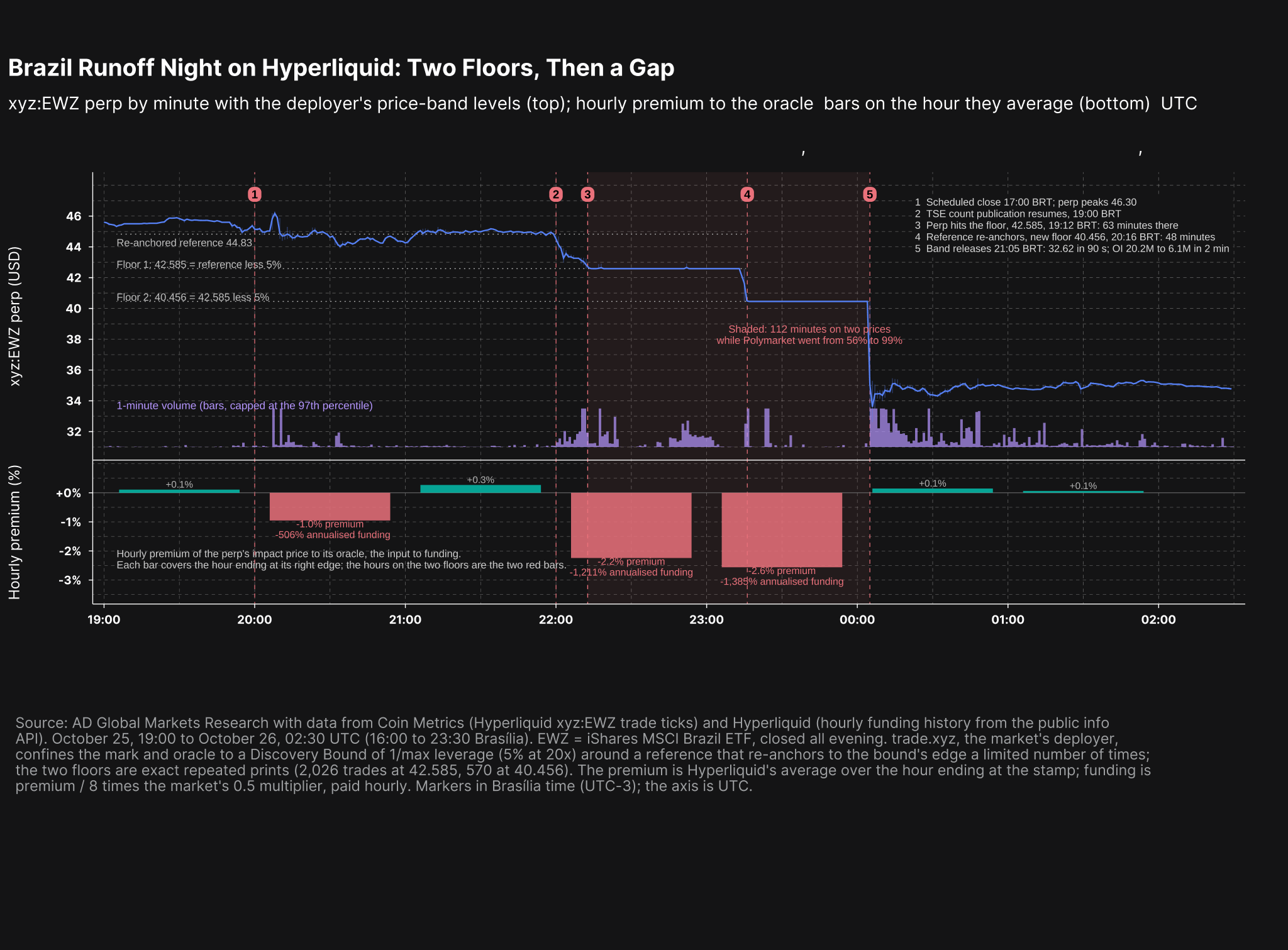
The band released at 21:05 BRT (00:05 UTC), with 94% of voting sections counted and three minutes before the election result was declared. The contract settled around 34.5 to 35, 23% below its pre-count level, and it gapped again to 30.29 at 05:00 BRT (08:00 UTC) on Monday before recovering, the US cash open printed 31.76.
It’s important to keep in mind that the Hyperliquid EWZ contract is small, with only $33 million of open interest at its peak on Monday. A more liquid contract could have taken longer to hit the 5% discovery band limits but would likely eventually face a similar problem. The takeaway for RWA perps more generally is that while these contracts never close, their reference prices can, and when the underlying's value changes significantly while the reference is frozen, the perpetual market price is bound to the deployer's decision about when to move the oracle. This would have been much less of a problem if there existed a 24/7 EWZ spot market price, for example coming from a tokenized version of the ETF, robust enough that the oracle could use it as an external source.
Bottom Line
On October 25, Brazil’s exchange was closed and the world’s price discovery didn’t wait. Polymarket called the result minutes after the count resumed. The CME BRL future took a good seven minutes drifting in the wrong direction trying to find its footing but eventually found its path and dropped 10% below Friday’s close. The Hyperliquid EWZ perp reacted faster than the established CME BRL futures contract. For a thin, crypto-native contract on a closed underlying, that’s a remarkable result.
Unfortunately, the perpetual future reference price hit a limit-down barrier two times during almost two hours before it was able to find its level. These bands exist to safeguard the market integrity during the hours in which the underlying market is not traded, and with a more developed market structure they might cease to exist. For example, a 24/7 spot price, coming for example from a tokenized version of the ETF that is robust enough to serve as an external source, would allow for a live price to follow throughout.
Never-closing markets are already showing signs of meaningful price discovery. With more liquidity and an external reference price that never closes either, the first five minutes of Sunday night price discovery could become the whole night. That’s another reason why the recent partnership between NYSE’s parent company ICE and Trade XYZ, with the possibility of having perpetual futures negotiating alongside tokenized equities, is an exciting development for the infrastructure of the RWA market.
Disclaimers
Custody, settlement, staking, and governance services are offered through Anchorage Digital Bank National Association (“Anchorage Digital Bank”). Digital asset trading services are provided by Anchorage Hold LLC (“Anchorage Hold”). Agency trading services are offered in New York by Anchorage Digital NY, LLC. BitLicense #0000041. A1 Ltd. is a principal trading business.. Anchorage Digital Bank and Anchorage Hold are not registered with the SEC or any state authority as a broker or dealer and are not authorized to engage in the business of the offer, sale, or trading of securities. Anchorage Digital services are offered to institutions and certain high net worth individuals in limited circumstances. Certain trading services are designed and available only for institutions who meet eligibility requirements, including qualification as an Eligible Contract Participant (ECP) under the rules of the U.S. Commodity Futures Trading Commission. For institutions participating in custody, staking, or governance with Anchorage’s Singapore entity, those services are offered through Anchorage Digital Singapore Pte Ltd (“Anchorage Digital Singapore”). Anchorage Digital does not provide legal, tax, or investment advice or private banking services. There can be no assurance that any cryptocurrency, token, coin, or other crypto asset will be viable, liquid, or solvent. No Anchorage Digital communication is intended to imply that any digital asset services are low-risk or risk-free. Digital assets held in custody are not guaranteed by Anchorage Digital and are not subject to the insurance protections of the Federal Deposit Insurance Corporation (FDIC) or the Securities Investor Protection Corporation (SIPC).
“Anchorage Digital Prime” is a trade name for a suite of digital asset products and services. It does not refer to any one specific legal entity. All services are provided by one or more of the specific Anchorage Digital entities. Custody, settlement, staking, and governance services are offered through Anchorage Digital Bank National Association (“Anchorage Digital Bank”). services are provided by Anchorage Hold LLC (“Anchorage Hold”). Agency trading services are offered in New York by Anchorage Digital NY, LLC. BitLicense #0000041. A1 Ltd. is a principal trading business. Anchorage Digital Bank and Anchorage Hold are not registered with the SEC or any state authority as a broker or dealer and are not authorized to engage in the business of the offer, sale, or trading of securities. Anchorage Digital services are offered to institutions and certain high net worth individuals in limited circumstances. Certain trading services are designed and available only for institutions who meet eligibility requirements, including qualification as an Eligible Contract Participant (ECP) under the rules of the U.S. Commodity Futures Trading Commission. For institutions participating in custody, staking, or governance with Anchorage’s Singapore entity, those services are offered through Anchorage Digital Singapore Pte Ltd
About Anchorage Digital
Anchorage Digital is a global crypto platform that enables institutions to participate in digital assets through trading, staking, custody, governance, settlement, stablecoin issuance, and the industry’s leading security infrastructure. Home to Anchorage Digital Bank N.A., the first federally chartered crypto bank in the U.S., Anchorage Digital also serves institutions through Anchorage Digital Singapore, which is licensed by the Monetary Authority of Singapore; Anchorage Digital NY, which holds a BitLicense from the New York Department of Financial Services; and self-custody wallet Porto by Anchorage Digital. Anchorage Digital Bank also offers fiat custody services through the use of an FDIC-insured, licensed sub-custodian. Anchorage Digital is funded by leading institutions including Andreessen Horowitz, GIC, Goldman Sachs, KKR, and Visa, with a valuation of $4.2 billion. Founded in 2017 in San Francisco, California, Anchorage Digital has offices in New York, New York; Porto, Portugal; Singapore; and Sioux Falls, South Dakota. Learn more at anchorage.com, on X @Anchorage, and on LinkedIn.
This post is intended for informational purposes only. It is not to be construed as and does not constitute an offer to sell or a solicitation of an offer to purchase any securities in Anchor Labs, Inc., or any of its subsidiaries, and should not be relied upon to make any investment decisions. Furthermore, nothing within this announcement is intended to provide tax, legal, or investment advice and its contents should not be construed as a recommendation to buy, sell, or hold any security or digital asset or to engage in any transaction therein.
Anchorage Digital Bank National Association offers fiat custody services through the use of an FDIC-insured, licensed sub-custodian.
